The final stop on our Galician road trip (read parts one and two here) was Santiago de Compostela, the capital of Galicia, and the most visited city in the region. We arrived at our hotel, located right in the center of old town, near the famed Cathedral of Santiago de Compostela, with just a few minutes to spare before our lunch reservation. We freshened up a bit and were off again.
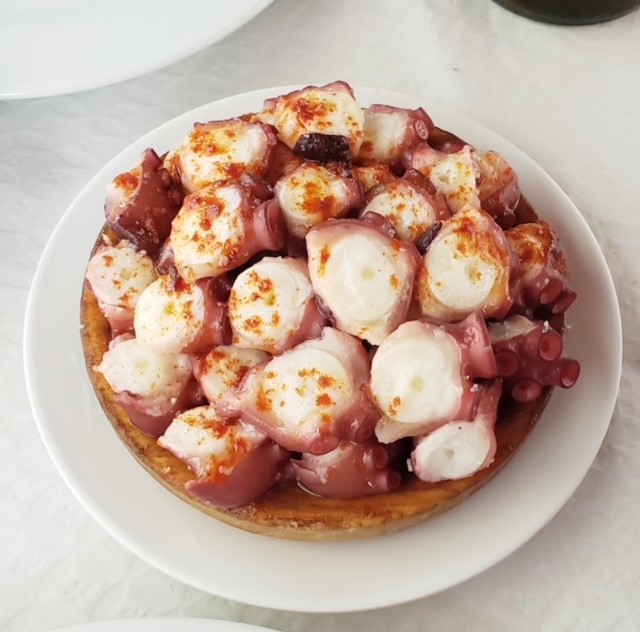
I had enjoyed the pulpo we had in Lugo so much that when I saw it on the menu at Restaurante Curtiña, I had to have it. We started with a platter of grilled veggies and a plate of pork shoulder with a fundido of Arzúa Ulloa cheese. When our pulpo arrived this time however, instead of being served in sliced chunks as we’d had before, we were served half of a grilled octopus…whole (er, half, as the case may be). If you read my blog regularly, you know I love to try new foods and I consider myself fairly adventurous with most things food related. Though I have to tell you, seeing that octopus was a bit unsettling.
The fact that looking at a whole damn octopus, all floppy arms and suckers, was unsettling made me think about why it was unsettling. Something that always surprises our Spanish friends when we tell them is the fact that in U. S. supermarkets, meat is rarely or never displayed in a way that resembles an animal, “with no faces” we say. People don’t want to look in the eyes or see the protruding tongue of the animal that will become their dinner. Is it because it just plain grosses us out to see dead things or because if we had to look in the eyes or see the hoof of the dead animal we were about to eat, we maybe wouldn’t want to eat as many dead animals? I don’t know. Food for thought (see what I did there).
I took a second look at the octopus and thought to myself, “Ok, let’s do this,” then hacked off a couple of tentacles and gave one to Phil and one to myself and we dug in. It had a similar delicious taste as we’d had before but this time it had been grilled over an open flame and had a bit of a steak-y flavor to it.
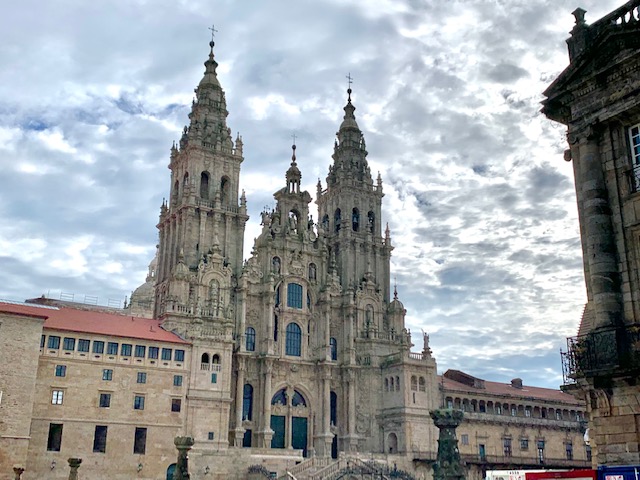
After lunch we walked over to the Cathedral. It was early evening by this time and it was closed but nevertheless remarkable. The outside is magnificent. In the square outside of the cathedral, we saw other tourists starring at the cathedral as well, some pilgrims (the name given to those who walk the Camino de Santiago) with their walking sticks and backpacks, relaxing after finally reaching their destination.
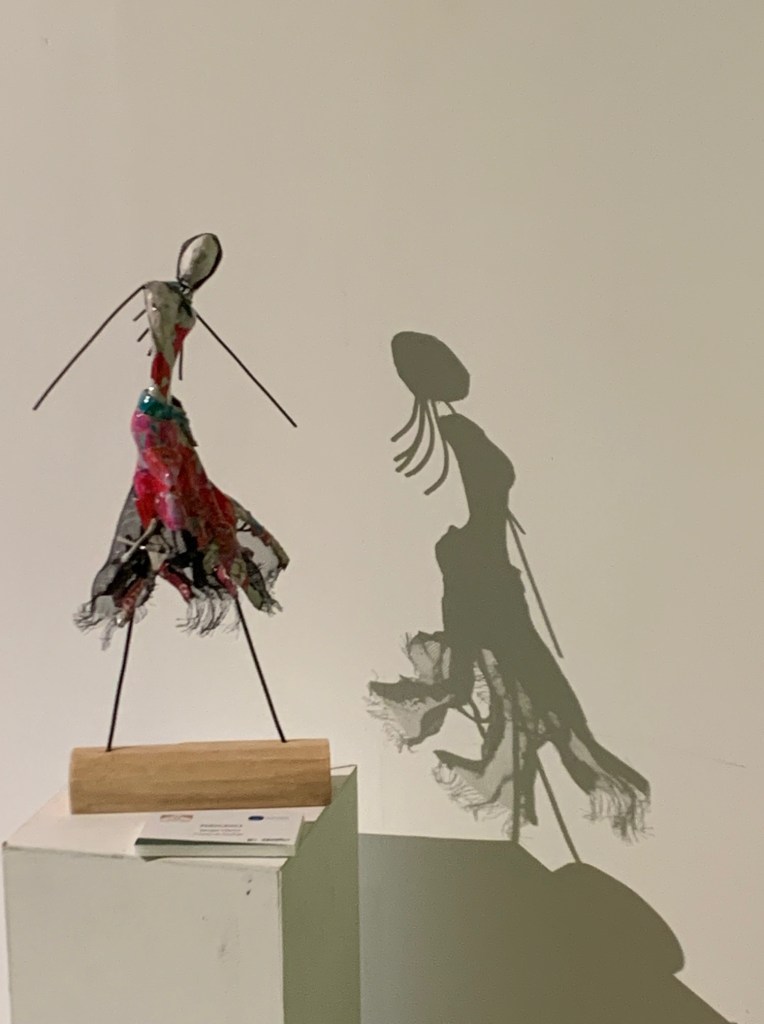
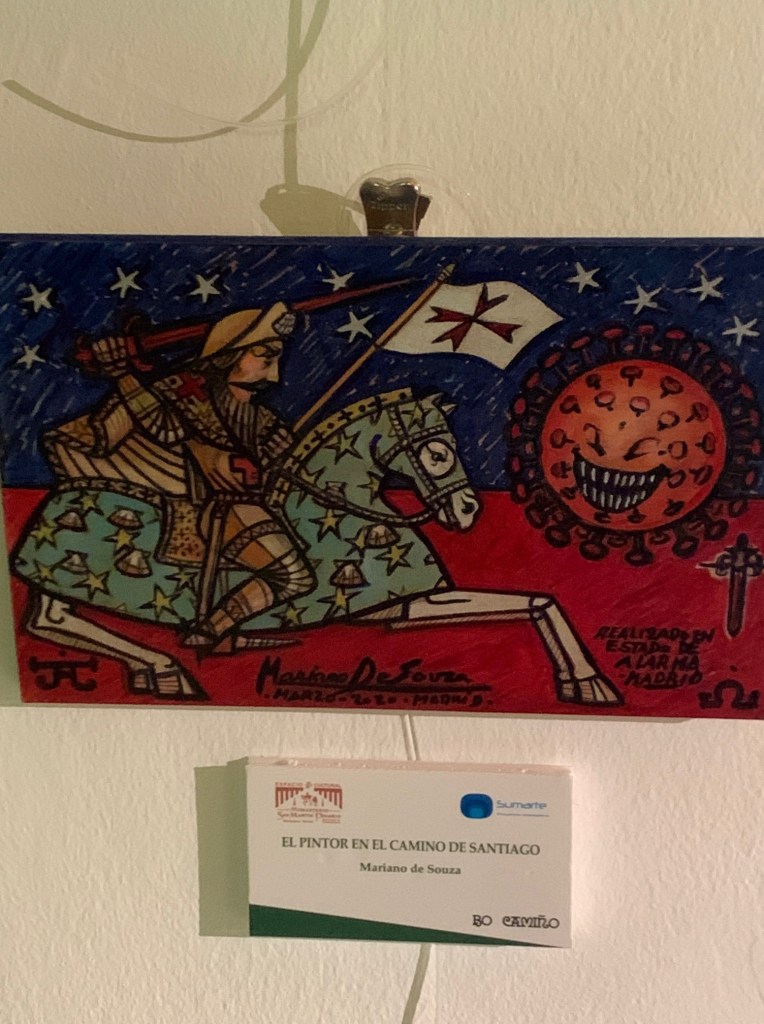
After the Cathedral, we walked on and wound up in front of Monasterio de San Martin Pinario. The grand front doors were closed but Phil spied an entrance on the side to the museum. We went in and upstairs found a small art gallery exhibiting primarily contemporary and camino-related paintings and sculptures.
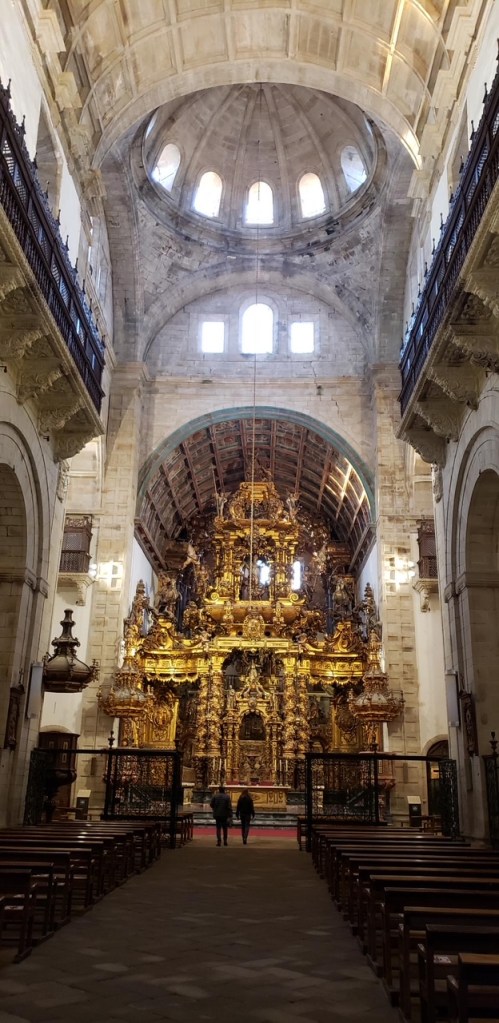
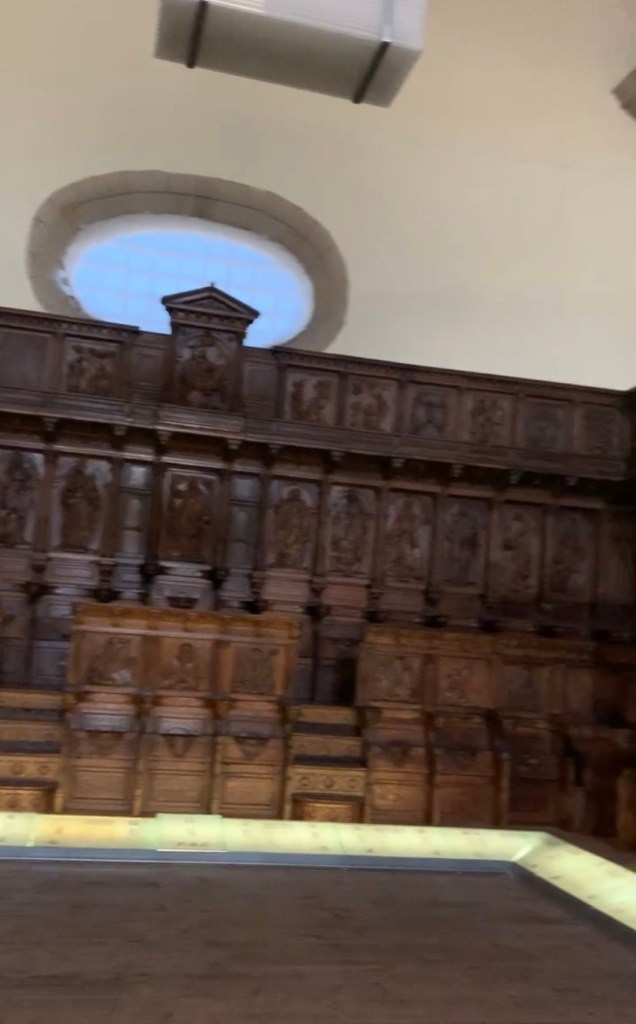
We went back downstairs and entered into the church. Holy moly. The alter was HUGE even by European catholic church standards. Typically, there is some sort of barrier prohibiting the public from entering the area behind the alter or rooms beside it. This church had no such barrier. The tiered choir seats behind the alter were just as impressive as the front had been.
From the choir seats
Ceiling
The altar
After exiting the alter to the room on its right, we discovered yet another grand, impressive room with domed ceiling filled with sculptures and huge paintings. Up another flight of stairs we went exploring; a room full of taxidermy animals, a room filled with priests’ vestments, golden chalices, incense and candle holders, and large crosses, and another room filled with various bottles that looked like an old laboratory. We ended up near the top of of the church’s domed ceiling, in an area that was backup choir seating. Old, wooden, lattice separated the area from the church and altar below. It was really cool being able to wander around the little hidden areas of the church. I always want to do that in old churches and the areas are either locked or section off which only adds to my curiosity.
The choir seats
Behind the lattice
Upon closer inspection
After wandering around the church for quite a while, we decided to head out for a couple of drinks. Still quite full from lunch, we figured we would perhaps get some raciones later in the evening. Well, we did not need to order any raciones as we were consistently served very generous, delicious, gratis tapas/pinchos with our drinks.
The next morning, after breakfast and a quick walk to look at the cathedral once more, we grabbed our bags, walked to the parking garage, and set out, homeward bound.
Phil wrote about our Galician road trip here. Check it out for more photos and a different perspective.
After leaving the city of Lugo, we headed to Ribeira Sacra. An area known for it’s wild beauty, breath taking vistas, and vineyards planted on the steep slopes of the valleys and canyons of the rivers Sil and Miño.
Our drive into the mountains was equal parts beautiful and terrifying, with narrow roads, blind curves, and huge drop-offs with small, or often, no guard rails. I was glad to be driving the manual transmission as we climbed and descended though I was not as glad to be driving the manual transmission when I had to parallel park between two cars on the side of a damn mountain or navigate an impossibly tight turn that was a real three-point situation, again, on the side of a damn mountain! Our good friend, Diana, who lives in Gijón, told me after we returned that she intentionally did not tell me about the mountain driving because she did not want to make me nervous. Good looking out, cause I am certainly glad she didn’t; I had to do it either way and best not to worry too much ahead of time.
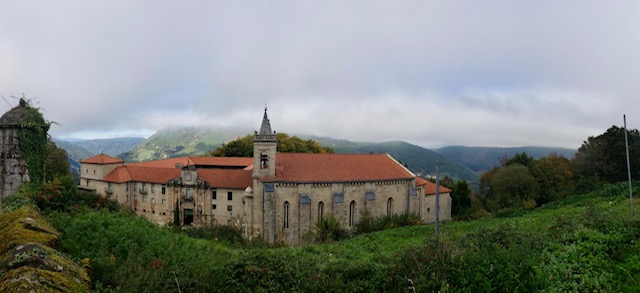
We could not check into our accommodations until 4:30pm so decided to check out one of the many monasteries in the area, Santo Estevo. Like the Convento de San Macos we visited in León, the Monastery of Santo Estevo has been converted into a luxury hotel by the Parador Hotel chain. Parador is a state run, luxury Spanish hotel chain that was established in 1928 as a means to promote tourism in the country. All of their hotels are located in adapted castles, palaces, fortresses, convents, monasteries and other historic buildings.
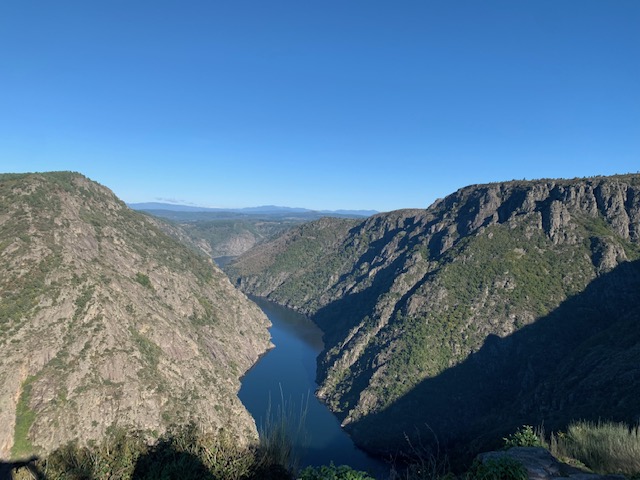
After walking around the monastery and grabbing a coffee in the hotel bar, we were back on the road, weaving and climbing through the breathtaking mountains. I pulled over at one of the periodic gravel pull-offs to take in a particularly gorgeous view and Phil noticed a sign for Mirador de Vilouxe pointing down a steep incline across the road. We still had time time to kill before our hotel opened so we figured, why not take a look. And what a look it was.
We parked our car as indicated ,near a small chapel and proceeded on foot through the town, following arrows and feet that had been spray painted on the ground, leading the way to the lookout point. Holy Moly. The views of the river Sil were truly awesome. We were up so high that being even near-ish (like eight feet back) to the edge of the cliff made me a little nervous. Ok, very nervous. It was totally worth the mild initial anxiety to stand, hand-in-hand with Phil and breath in the fresh air and take in the spectacular, wild, nature around us.
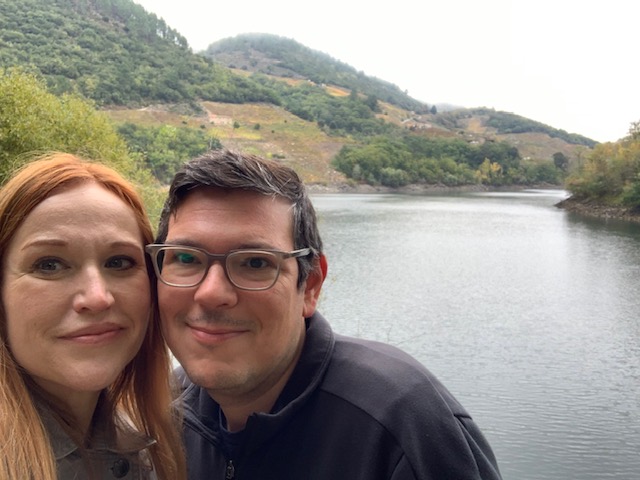
Our alojamiento rural (rural accomodations) near the town of Parada de Sil, Hotel Olar de Rabacallos, was down many winding roads, near the edge of the Sil river. It was carved perfectly into the hill in a truly stunning setting. We had a serene view of the river from our room and could see the many terraced vineyards all over the steep river banks. The hotel proprietor who greeted us was warm and welcoming. She showed us a well worn map of the area and pointed out different attractions that might interest us. We took a photo and thanked her, inquired about breakfast the next morning, and headed up to our room to relax for a bit before meeting up with a friend from our intercambio (language exchange) meetup group for dinner in Ourense, an hour’s drive west.
The next morning, we enjoyed a delicious breakfast of coffee, juice, toast from really, really good homemade bread, butter, jam, ham and cheese, and bizcocho (dense, yellow sponge cake). We enjoyed an extra cup of coffee outside, overlooking the Sil, respira el aire. We took a quick walk down to the water’s edge before packing up to hit the road toward our final stop of Santiago de Compostela. Even with the scary mountain driving, I would definitely go back to Ribeira Sacra. Kayaking the river Sil in spring or summer would be a dream.
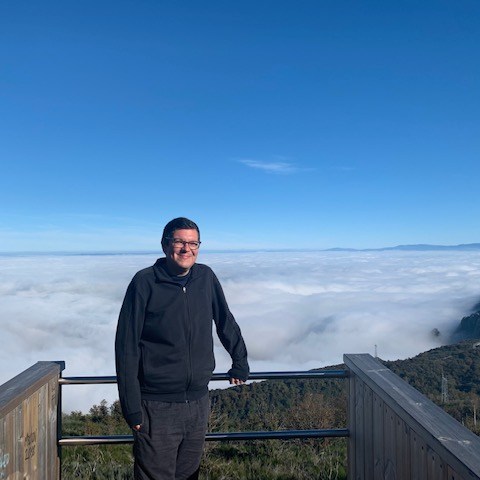
As we climbed up the mountain from the river’s edge, we just kept on climbing. Up, up higher than we’d ever been with views so beautiful I couldn’t look away other than to pray and stare at the winding road, of course. As we rounded a big corner, we passed a small look out area and pulled over onto the gravel. From there, we saw one of the most surreal things I’ve ever seen with both feet planted on the ground. We stood together, looking down on the clouds.
Above the clouds
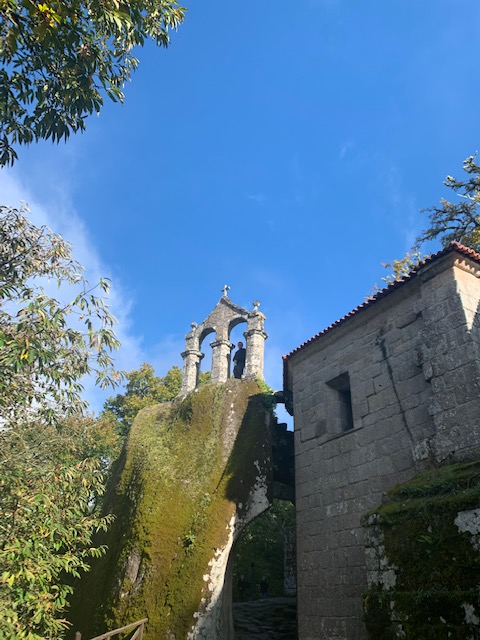
We made one more monastery stop before leaving the area. The Monastary San Pedro de Rocas, the oldest monastic complex in Galicia, built in the 6th century. It was a very happening spot late on a Sunday morning. They had a cute, little museum (with bathrooms!) that talked about the monks’ wine making. The large, outdoor structures (stone steps and magnificent archways) were more impressive than the building itself.
Just as the monastery was becoming overly crowded, we hopped back in the car, Santiago de Compostela bound.
For my birthday this year, we decided to take a road trip through Galicia, Asturias’s neighboring autonomous community to the west. I did not know a lot about Galicia before we left other than 1) it rains a lot there (even more than in Asturias), 2) the Camino de Santiago pilgrimage route ends there, and 3) it has great seafood, pulpo (octopus) in particular. My hair colorist was just telling me that he hates seafood but loves pulpo, “Me encanta pulpo,” he said. With the largest coastline in Spain, bordered both by the Atlantic Ocean and the Cantabrian Sea, Galicia has plenty of access to fresh seafood and every Spaniard we’ve talked with about Galicia has said how wonderful the food is there. If that weren’t enough, they also make great wine. I love Galicia.
We rented a car for the trip for the first time since being in Spain, and were excited at having the ability to go to places the bus or train cannot easily reach. We actually did a practice run with the car two days prior and took a lovely day trip to Cantabria (Phil wrote about it here). Phil never learned to drive a manual and I had never driven a six-speed before so after finally figuring out how to get into reverse, we were off and running with no problem.
We left Gijón at 5:30 and enjoyed beautiful views from the road until the sun went down. Out of a bus window, one can catch glimpses of the countryside but being in the drivers seat, I was able to fully enjoy the glorious rolling green hills and views of the Cantabrian Sea, eyes wide and mouth agape (all while driving safely and responsibly, I should add). As we neared the city of Lugo, we climbed a bit in elevation, as noted by the road signs, but could not see the mountains in the dark.
We arrived at our hotel, the Hotel Balneario de Lugo – Termas Romanas, a little before 8pm. The hotel sits atop the old Roman baths of Lugo and on the banks of the Río Miño. They have a small museum dedicated to the termas romanas under the hotel and a spa offering a variety of services incorporating the healing waters of the ancient hot springs. In fact, they had a promotion that included an overnight stay, breakfast, and an hour and a half thermal circuit incorporating four spa services. Bathing in the same thermal waters as the Romans did is pretty darn cool, and if they have healing powers, what a bonus!
Photo I borrowed from the hotel’s website
Something I had not thought of when booking the hotel was the fact that natural hot springs smell like sulfur aaaaaand the hotel sits atop of the natural hot springs and well, the hotel smelled like sulfur. Oh well, no problem. I went to high school in a town in mid-Missouri that had sulfur smelling water and believe you me, there were no healing properties to it.
The hotel felt like one of those places that used to be very swanky but is no longer in it’s prime, clean and in good shape, just a bit dated. The reception staff were very nice and helped us make our spa appointment for the next day. They would bring us chanclas (flip flops) and robes in the morning; we just needed to put on our bathing suits and flip flop our way on down to the reception desk. Bathing suit? Damn! I forgot my bathing suit. Luckily there was a Carrefour (basically Spain’s Walmart) less than five minutes away. We could run there in the morning and grab a suit. Phew.
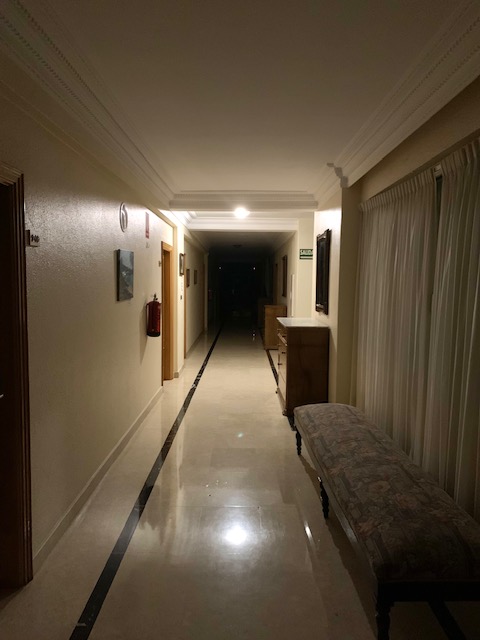
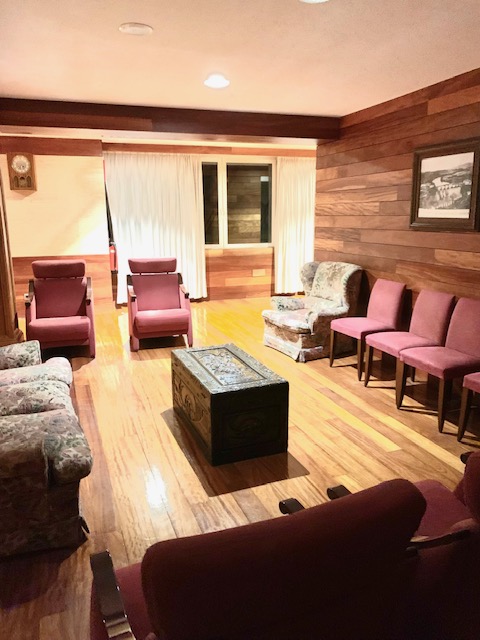
As we exited the elevator to our room, motion sensor lights came on to reveal a large sitting area with ten 70+-year-olds relaxing on the chairs and couches. It was a little startling and we offered a quick “Hola” before heading down the hallway to our room. Had those folks just been sitting quietly in the dark before we arrived? As we rounded the corner towards our room, I noticed how wide the hallways were. That, in addition to all of the sitting areas, and the way in which our room was decorated made me say to Phil, “I think we’re staying in an assisted living facility.” We both chuckled a bit but having worked in assisted living facilities and nursing homes, I know a geriatric residential setting when I see one. What the heck was going on here?
From our room, we took in the beautiful view of the Roman bridge over the Miño river, and set out to find food. Given that we were in a mountainous region, we did not escape climbing (escalar, escalar) our way into town. Phil did a quick search of nearby restaurants and found a well rated burger place. I was tired and a burger sounded great. I decided my Galician seafood feast could wait for another day.
Phil on the Roman bridge
It was significantly colder in Lugo than in Gijon and when we arrived at the restaurant; it was in the low forties. We had, however, just made a long walk and steep climb, so were keen to sit outside. We had coats on and the tables were situated under a large awning, so the periodic misting rain was no problem. The La Urbana Burger Bar had very friendly and quick service which is not necessarily the norm for Spain. It was nice to be a bit catered to after our drive and climb. The waiter even offered unsolicited recommendations which were much appreciated. Phil had the Italian burger with salami, mozzarella arugula, marinara, and balsamic and I the Urbana Piamonte which had tomato jam, crispy onions, smoked bacon, and gorgonzola. We each had a beer to wash it down and it was perfection. We were quite full and decided against desert until the waiter recommended the blueberry cheesecake with Oreo crust. I didn’t want to hurt his feelings, so we ordered one to share. It came in a cute little jar and was heavenly.
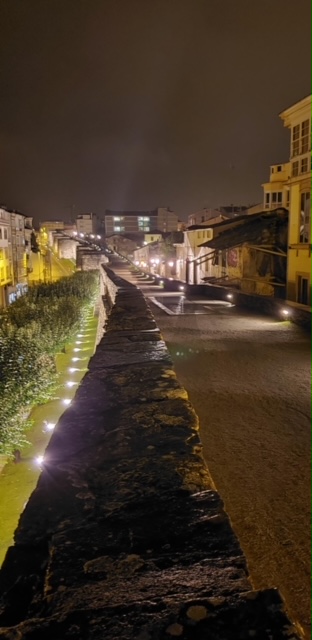
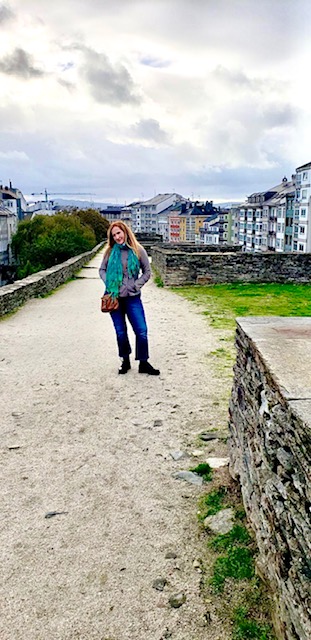
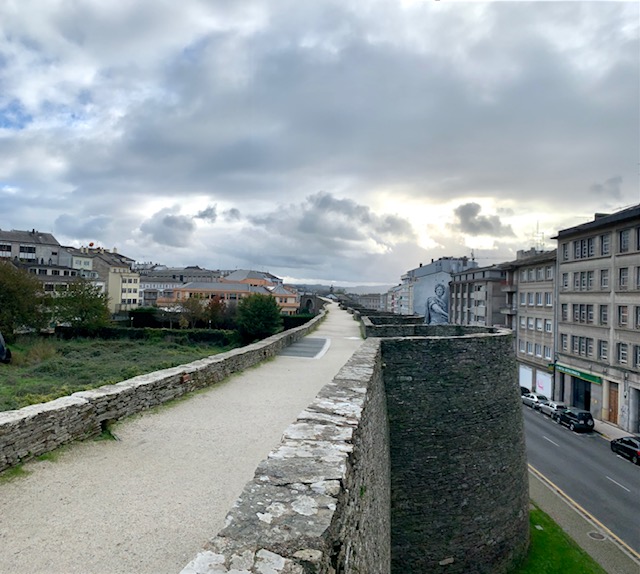
We took a slightly different route back to the hotel after dinner and passed the city center and Roman wall so, of course, had to check it out. Lugo’s city center is entirely enclosed by two kilometres of Roman wall which is still intact. In fact, one can walk around the entire city center on top of the wall. It is very cool and a real must see if you’re in Galicia, en mi opinion.
Atop the Roman wall at night
As we returned to the hotel, we could see a large group of older adults in the cafe/bar area enjoying refreshments, singing and dancing with a few folks who appeared to be younger, employees of the “hotel.” “This is definitely an assisted living facility!”, I screeched to Phil.
The next morning, I pulled up the hotel’s website as I thought I’d seen something about a senior discount when booking and I needed to know what was up with all of the old people. Upon further review, I discovered they offer two week packages to “pensioners” which includes daily spa treatments under the supervision of the spa doctor. It all made sense. I wasn’t crazy. There were a lot of old people staying there and it is kind of like a residential living center.
After my internet sleuthing, we had breakfast in the cafe. We were lucky to score a table as it was relatively full. We were the youngest people there by at least 30 years. They offered a number of choices and we each had toast with butter and jam, fresh pears, orange juice, and coffee. As we left, Phil pointed out that one of the tables close to us also had a plate of sliced ham and cheese and said we should get that the follow morning.
After breakfast, we were off to buy a bathing suit. Unfortunately, there were no bathing suits to be found so a black sports bra and black pair of polyblend undies would have to suffice. Close enough.
We were back at the reception desk in our robes and chanclas at 11am sharp. The young woman working handed me a slip of paper and advised us to go downstairs and give it to the woman in the spa. I did and shortly thereafter, another woman lead us down a stone hallway with tiny rooms. We disrobed and de-masked in one room and were taken to another. This one had a shower in it. It looked like a semi-circular, cylindrical metal cage. One stepped into it and hundreds of tiny jets of water tickled and massaged the body. It went roughly from the armpits to the knees. I took my turn in the shower as the woman led Phil into the room across the hall. After about ten minutes, we switched rooms. In my new room, the woman sat with a large hose and proceeded to spray me down, like a prisoner or a zoo animal. As soon as the warm water hit my joints and she strategically used the water to massage the body, those thoughts melted away. It felt amazing.
Next we were off to the large thermal pool. There were individual metal railings on the pool’s edge that one could hold on to and face forward or backward as underwater jets messaged the body. Eyes closed, turning forward and back as felt good, we relaxed in the healing waters, straight up Cocoon-ing with the older folks.
After exiting the pool, the young attendant handed me a small packet wrapped in plastic. I asked her to repeat what she’d said as I didn’t understand. I still wasn’t exactly sure but I thought she indicated I could go into the locker room and put my wet “suit” in it. I motioned to my suit and then the bag and she replied “exactamente.” I went into the locker room, showered, then opened the little packet to get what I assumed was a small bag. It was not. It was a pair of paper underwear. Confused, I put them on and assumed the last treatment must be some sort of message. I put my robe on over them and stepped out of the locker room as I heard Phil call my name. At the door of the men’s locker room he asked, “did you put that thing on that they gave you? I thought she was giving me an extra mask.” I responded that I did and he disappeared back into the locker room. He emerged directly and we were ushered to a dark room with soothing music. They had what looked like fancy lawn chairs covered in sheets. The woman indicated we should take our robes off and sit down under the top sheet. We did and she left the room for a few minutes then returned with orange juice and this glorious mentholated lotion that she rubbed our legs down with. Another woman came in and put a heavy, weighted (it reminded me of the lead apron they put over you for ex-rays), warm-something-wonderful on our backs. We sat in silence and were completely and totally relaxed. It was fantastic.
After our spa treatment, it was time to eat! In search of pulpo we went. We were glad to find a restaurant called A Lareira. After a half hour walk and all of the spa-ing, I was really hungry. I proceeded to order the pulpo, fried calamare, and corquettes. The waitress stopped me, mid-order and indicated I was ordering too much food and that if I was still hungry after what she brought, we could always order more. I appreciated that and sat back and waited for the delights to come. She returned with a bottle of white wine, bread, un montón (heap) of pulpo, boiled potatoes, pimientos de Padrón, and a plate of croquettes.
The pulpo did not disappoint. It has a very meaty texture like lobster and the flavor, to me, was a bit like delicious, salty pork. It was dusted with a spicy paprika. The croquettes were amazing and unlike any others we’ve had. Some were filled with a squid ink béchamel, the other with traditional jamon and béchamel, and the third with something that tasted like lobster bisque. It was all excellent.
After lunch, we were off to see the Roman wall in the light of day. It is incredible that it is essentially all intact and you can take a stroll on it.
The next morning we grabbed breakfast in the hotel cafe again before viewing the small Roman baths museum in the hotel, and hitting the road. The waitress started listing our various breakfast options. I again ordered juice, coffee, fruit, and toast with butter and jam. Phil said, “I thought we were going to get ham and cheese?” to which I responded, “I liked my toast and jam yesterday.” He then told the waitress that he wanted the same thing I ordered AND ham and cheese. She then asked us if we also wanted her to bring bizcocho as well. We said yes even though we had no idea what it was because well, we like food. We figured it sounded like biscuit and biscotti and we like both of those things so why not. She returned with a plate of yellow cake that was delightful and tasted like a cross between sponge cake and pound cake. She then brought us everything else we ordered, including a large plate of ham and cheese. I realized that when the waitress was listing off breakfast items, she was telling us everything they had. We didn’t have to choose. We could have it all. I could have toast and jam AND ham and cheese. I wasn’t taking more than my share. I wasn’t asking for extra. It was all included and all I had to do was ask for it.
Often we impose limits on ourselves based on false perceptions or assumptions. We don’t ask for or seek out all we really want because we like what we have just fine. We can’t see beyond our current circumstances or limitations because we don’t look. We do not even know to look. I’m glad that Phil reminds me to look. Load up on the good stuff. There’s a long road yet to travel. All you have to do is ask for it.
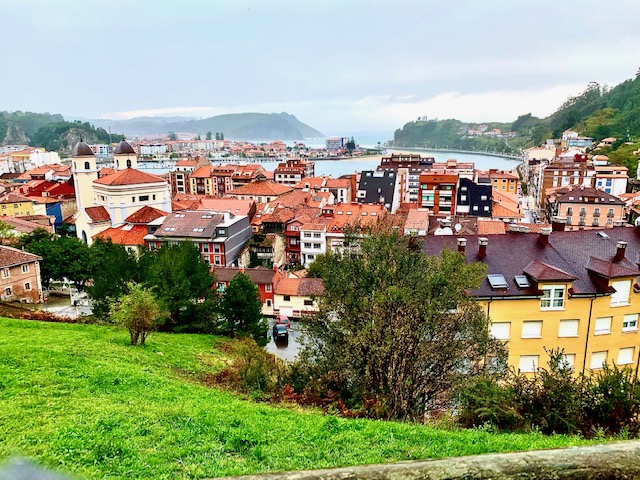
Part 2 coming soon! Below is a photo dump from our day trip El Capricho de Gaudí in Cantabria and pit stop in Ribadesella that Phil wrote about. Enjoy!
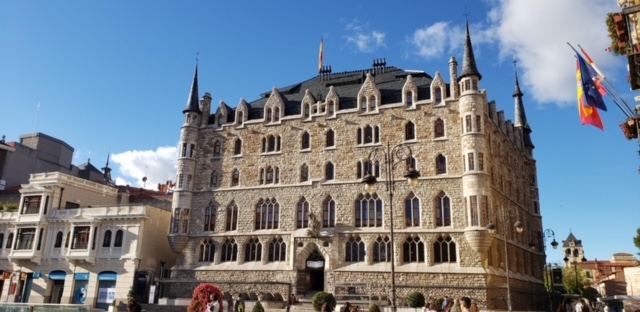
We returned to León from Astorga on Friday afternoon and headed back to our hotel to freshen up a bit. On the way, Phil grabbed us an empanada with something amazing inside (a mix of sausage, cabrales cheese, and a sweet tomato sauce) and a slice of layered cake with custard and toasted meringue. Not too shabby for a quick travel lunch. Since we weren’t able to tour the Palacio de Gaudi and I wanted a Gaudi fix, we made our way to Casa Botines, another Gaudi designed building.
I really like Gaudi’s style. When we were in Barcelona in 2008, we visited Park Güell and saw the outside of the famed Sagrada Familia. His style is often referred to as Catalan modernism with neo-gothic and art nouveau influences. I refer to it as fairy-tale trippy. Either way, it’s super cool.
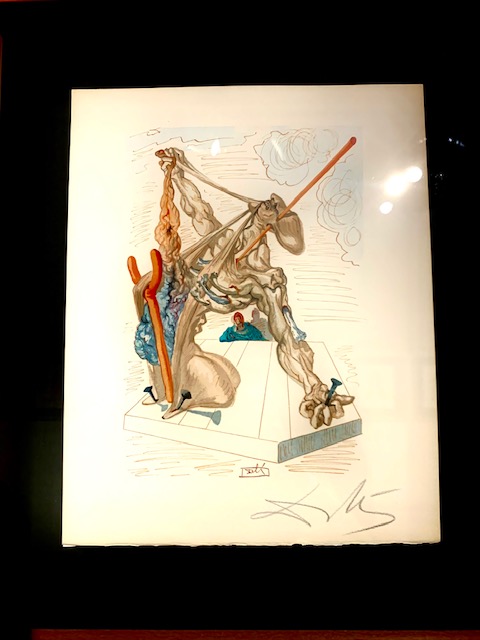
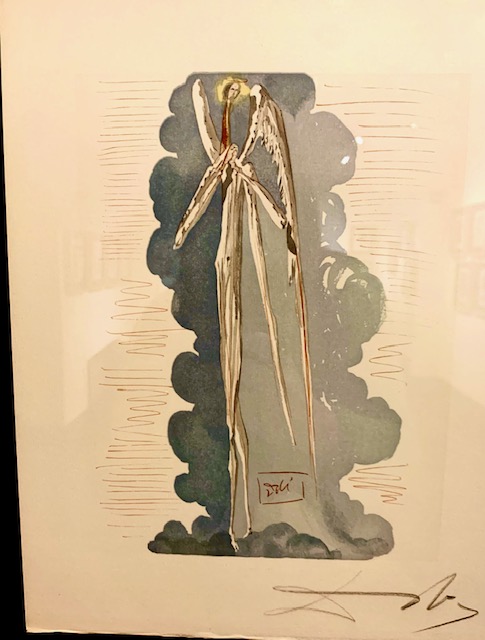
Casa Botines was designed and built for a fabrics company with the owner’s residence and company offices on the first floor and rental property (tenements and medical and business offices) on the upper floors. Ironically, the coolest thing about our visit to Casa Botines wasn’t the architecture, it was a Salvador Dalí exhibit tucked away in a relatively small room on the third floor. In the late 1950’s, the Italian government commissioned Dalí to illustrate Dante’s Divine Comedy in celebration of the Italian author’s 700th birthday. The commission eventually came to nothing due to international uproar at the fact that a Spanish, not an Italian, artist was chosen for the job. Dalí wanted to finish the project anyway, and between 1959 and 1963, completed one hundred and one water colors illustrating particular scenes from the Divine Comedy. Approximately thirty of these, signed prints are a part Casa Botines’ permanent collection, and, as you can see below, are extraordinary.
After Casa Botines it was time to eat. We hit up a few tapas bars and munched on a couple of raciones. The biggest score of the night was a small plate of croquettes that tasted like jalapeno poppers and a dish called morcilla de León. Morcilla de León that looks a bit like and has the consistency of Texas chili con carne (without beans). The flavor is a bit smokier with just a hint of sweetness. It was hearty and warming and delightful. We happily spooned it into our mouths with the chunks of bread provided.
I enjoyed it so much, I googled it to see what was in it as I was confounded as to what exactly I was tasting. Mocilla de León (sometimes referred to as Spanish black pudding) is blood sausage that traditionally contains only pig’s blood and onions (what!?!), though often breadcrumbs, rice, fat, and/or other spices are added for texture and flavor. It is cooked in a bit of water for a period of about ten minutes and served in a clay pot as raciones or tapas. So my favorite Leonese delight is onions and pig’s blood with a little water? Well, it’s delicious so yes, I guess it is. I guess it is.
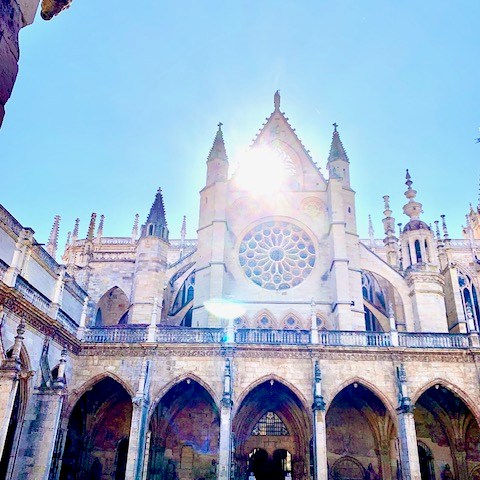
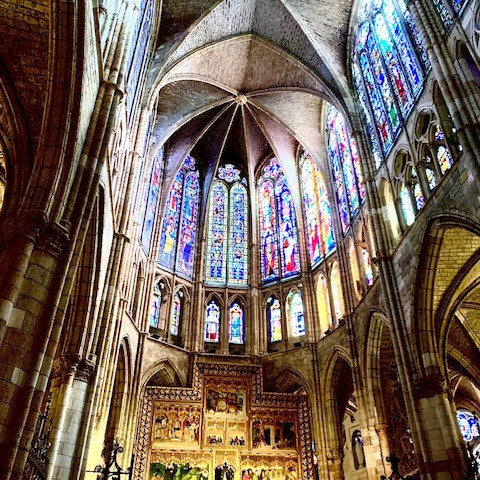
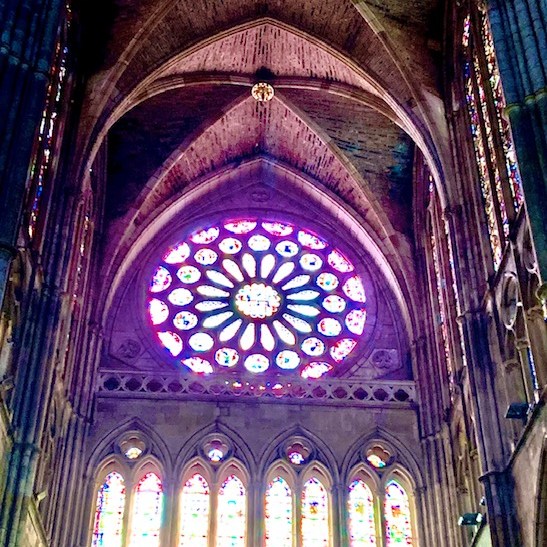
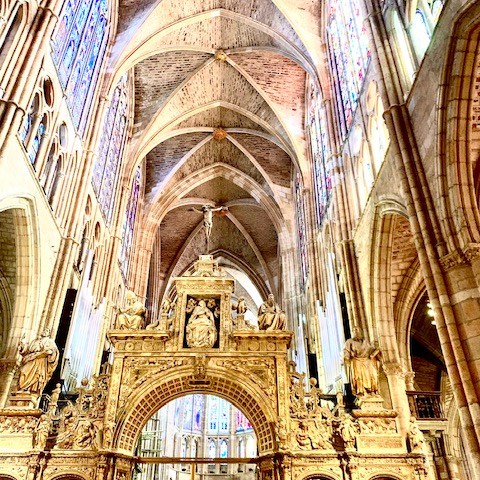
The next day we slept in, left our bags at the front desk of the hotel, since our train home to Gijón didn’t depart until late in the evening. Our first stop after leaving the hotel was the Santa María de Regla de León Cathedral, or Cathedral de León for short. We had been advised it was a must see even though they do charge an entrance fee, something we are usually not inclined to do at churches. We both really like stained glass and the Cathedral promised some of the most beautiful in Europe, so we paid the fee. It was well worth it.
The cathedral is one of the greatest works of Gothic architecture in the world with vaults and arches as far as the eye could see. The stained glass was everything we’d been promised and the midday sun illuminated the colors brilliantly.
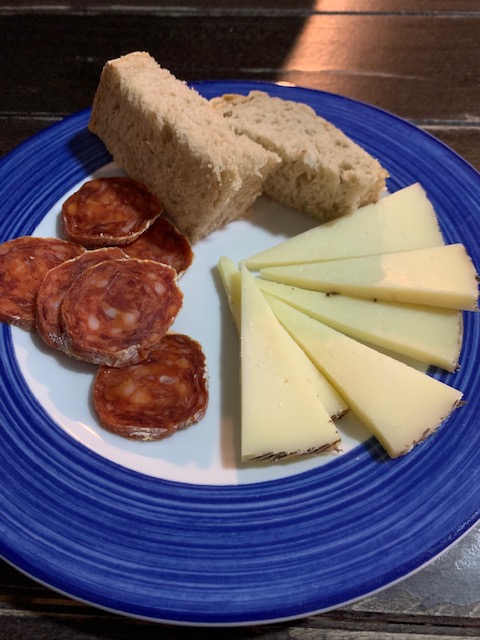
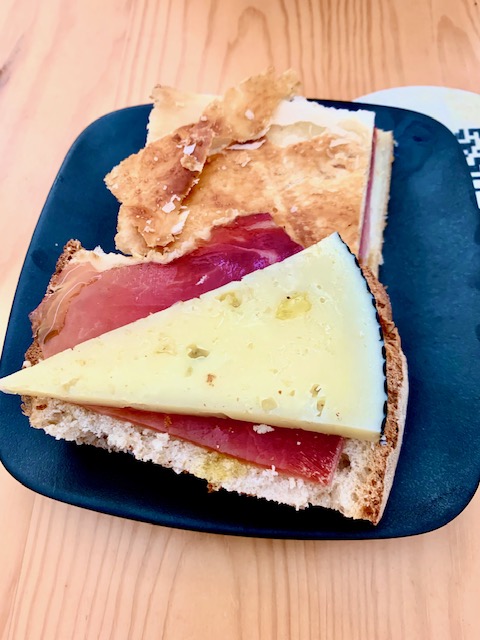
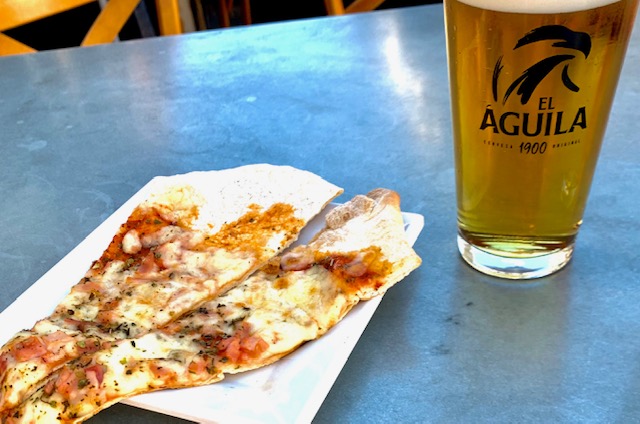
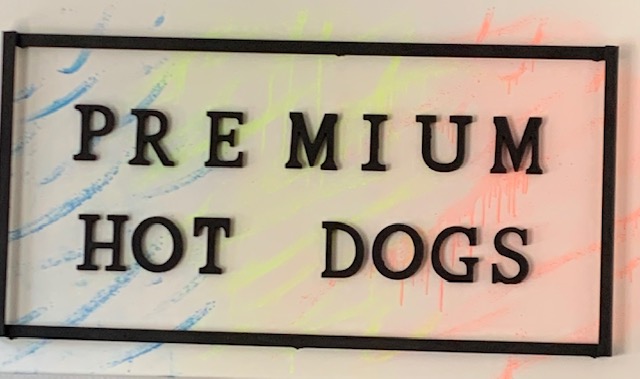
After visiting the cathedral, we decided to have a tapas lunch. It was Saturday so old town was really bustling. The first place we stopped at gave us slices of pizza, not exactly a Leonese delicacy (I mean, pig’s blood and onions is pretty tough to beat) but it was pizza so by definition, pretty good. After this we wandered a bit to try to find a quieter place slightly off the main drag. We were successful and enjoyed some cured meats and cheeses. Still not satiated, we were off again to find something more substantial. We found ourselves on the street directly behind the Cathedral. It was nice and quiet. We didn’t pass anyone else and enjoyed a peaceful walk beside an old, stone Roman wall. On our walk, we happened upon a restaurant selling specialty hot dogs. Phil and I aren’t people who eat a lot of hot dogs typically but given the right situation, say, a baseball game or outside of a concert off a makeshift grill at 2am, we are all about hot dogs. Phil asked me which one we should get (we shared one and it was a good thing we did because it was HUGE). I responded, “the one with macaroni & cheese and bacon, duh.” And so, we had a giant hot-dog with macaroni & cheese and bacon and a plate of fries for lunch. “Que muy Americano” I told the young fellow working the counter. He explained to us that though he had never been to the US, he imagines when he does, the food will be much like what they serve. He’s not wrong.
After lunch, we walked over to check out the Convento de San Macos. A former convent and jail that is now a five-star hotel, with the exception of the attached church and small museum. The church and gratis museum did not take long to tour and we decided to go into the hotel and look around. We first stopped in the hotel bar for a coffee before moving on to the upper floors and lovely indoor courtyard. Phil wrote in more detail about it here.
Overlooking the hotel courtyard
After San Marcos, we walked to the MUSAC (Museo de Arte Contemporaneo de Castilla y León). They had a wonderful exhibition by the Polish artist Goshka Macuga. Phil also writes about our trip to the MUSAC so I won’t go into detail other than to say it was a very enjoyable visit and I highly recommend a trip should you find yourself in León.
Museo de Arte Contemporaneo de Castilla y León
After the MUSAC, we slowly made our way back to the hotel to pick up our bags but not before having one more tapas snack for the road. We were given a small plate of bollo embarazada (pregnant bun) filled with chorizo and we ordered a raciones plate of Morcilla de León…when in León.
As we boarded our train, I settled in for a comfy ride home to Gijón, feeling warm and happy, beyond pleased with our fall weekend trip to León.
León has been on our list of places to visit since we arrived in Spain. Phil and I have heard great things plus it’s only an hour and a half drive (3 hours by train) from Gijón. León is not in Asturias but located in the autonomous community of Castilla y León (a bit like Asturias’s much larger neighboring state to the south). A day trip from Gijón to León is totally doable but we are not fans of rushing. Hurrying through a church, museum, or other location simply to check it off “the list” and speed off to the next, must see, nearby attraction is not enjoyable to us. We would rather take our time experiencing one cultural attraction fully than rushing to pack in three. I know this isn’t everyone’s style and that’s ok but because it is our style, we opted to spend a couple of days and nights in León, seeing the sights and of course, eating the eats!
Before we left Gijón, our friend, David, who is from León gave us a run down on must see spots and other cool attractions as well as the neighborhoods to eat in. We had a general idea of what we wanted to do and see but it was great to be able to tweak our itinerary based on the recommendations of a native Leonese.
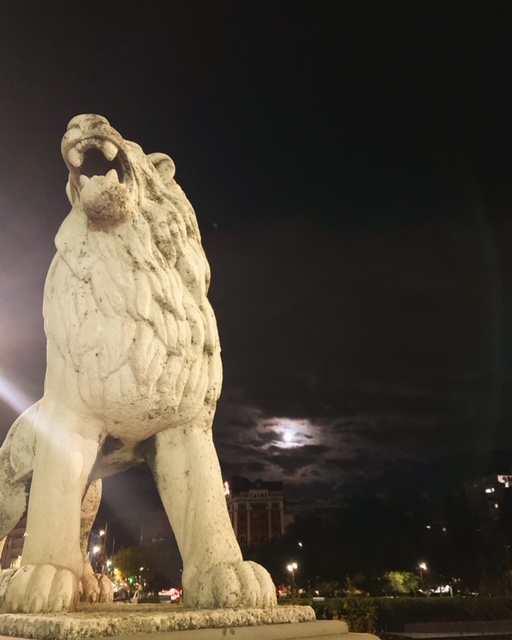
We arrived in León via train around 10pm on Thursday night and walked from the train station to our hotel, crossing the Bernesga River, with the moon large and bright in the distance. As we walked the air was cool and crisp; refreshing with its fall bite. There is something about the air in autumn that is so exhilarating, almost electric, like something thrilling is about to happen but I have no idea what. I love that feeling.
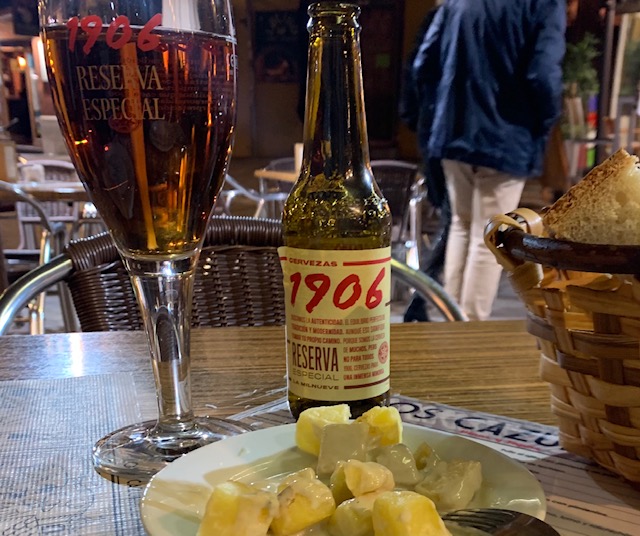
We found our hotel, dropped off our bags, and headed to the old part of town called Barrio Húmedo for something to eat. León is known for serving generous tapas plates with wine or beer. A bit like the gratis pinchos you find in Gijón but more substantial. David informed us that the tradition is called “ir de vinos” (to go with wine). One can even order what is called a corto de cerveza which is a very small (about a double shot) glass of beer which is quite inexpensive and still enjoy a nice plate of gratis tapas. Generally one can find the ir de vinos from 1-3pm in the afternoon and 8-10pm.
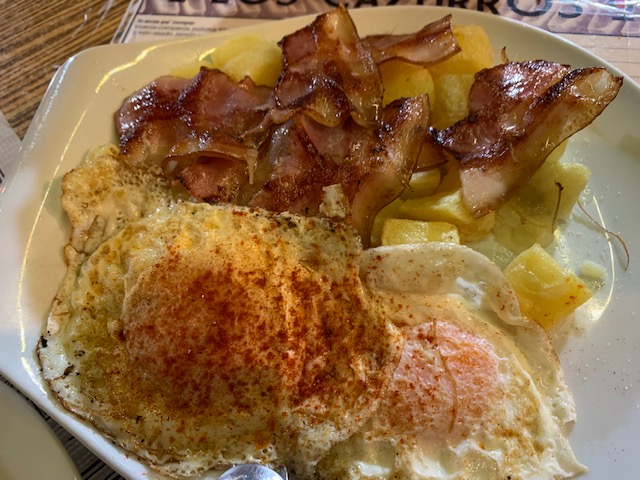
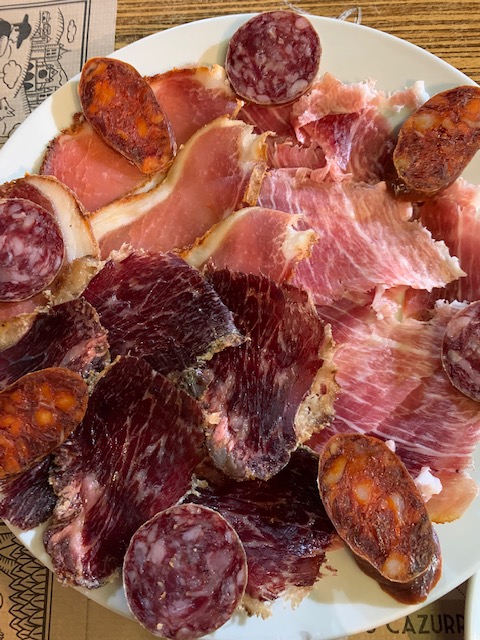
By the time we made it to old town that evening, we needed something a bit more substantial so opted for a couple of plates of raciones. Raciones are to be shared and are a bit like appetizer platters in the U.S. We were still served a gratis plate of fried potatoes with cabrales (Asturian blue cheese) sauce which was delicious and much appreciated. We ordered a plate of cured Leonese meats and a plate of potatoes, bacon, and eggs. We decided to to share a desert of cheesecake as well (with sprinkles!). Por qué no? All was delicious and along with our cerveza toastadas (toasted or brown beer) helped to keep us warm in our seats on the patio as the temperature dipped to 6°C (42°F).
The next morning, we caught the 10:15 bus to Astorga, a 45 minute bus ride south east of León. The day was sunny and bright and the glorious autumn air was in full effect. We have had a lovely fall in Gijón thus far, particularly after having spent our past five autumn’s in southern California where there isn’t a real seasonal weather change to speak of. León’s otoño (autumn) was poppin. Not only was there the sunny, crisp weather I love so much but also many more colorful leaves than I have seen in Gijón. The bus ride to Astorga was beautiful with rolling hills of autumnal colors. One particular stretch reminded much of where I grew up in Missouri. I even leaned over to Phil and whispered, “It looks like we’re driving from Gravois (where my folks live) to Versailles (neighboring town).”
Astorga has a very quaint, welcoming, small town (pop of 11k) feel. There were a few sites we wanted to see but first we needed to eat. We happened into a cozy cafe and ordered. I had a cafe Americano and a nutella croissant and Phil an espresso and tortilla. Everything was quite tasty and as we ate I kept eyeing the donuts on the bar; small, plain donuts with a dusting of powdered sugar. Not sure when we would be eating lunch and knowing we’d be doing a lot of walking, I ordered another cafe Americano and a donut, you know, to keep my wits sharp and my muscles strong. They brought us two donuts and I was nice enough to share my treats and coffee with Phil before moving onto the Museo Romano.
As with many towns in Spain, Astorga has uncovered Roman ruins through archaeological excavations of the city. They had several well preserved tombstones of soldiers, slaves, and freemen along with tools, coins, and jewelry. I am certain Phil will post much more info on the museum given his love of Roman history.
Roman Tombstone
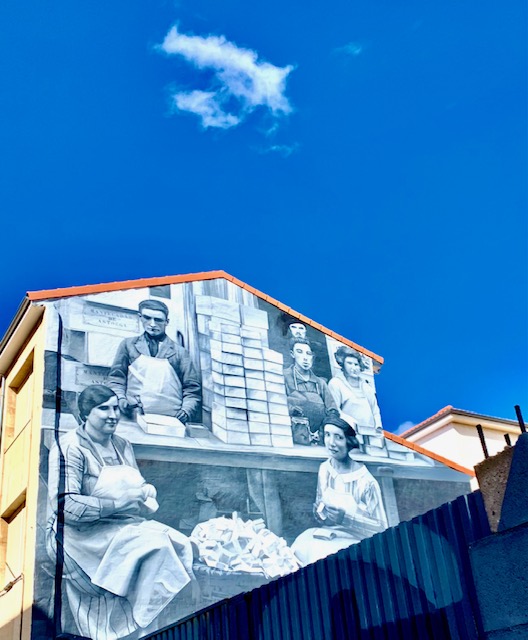
After we left the museum, we headed over to check out the La Catedral de Santa María de Astorga and the Palacio de Gaudi. Unfortunately, both closed from 2-4pm for lunch and even though it was 1:30, they would not let us purchase tickets as we wouldn’t have enough time to view either before they closed. The tough choice was, wait around until 4pm and get back to León near dinner time or take the 2:30 bus back and check out some of the sites before the end of the day. The Palacio de Gaudi looked so cool, like a fairy-tale castle from the outside. Part of me really wanted to stay but since I was still full from breakfast, making eating lunch from 2-4 a less than ideal option, we opted to take the bus back and make the most of the rest of our afternoon in León. On our leisurely walk to the train station, we spotted several cool murals on buildings throughout the city.
Florence is beautiful; the architecture, the art, the food, and there are so many restaurants to accommodate the so many tourists. We thought that going in late September, after school started, outside of the peak summer season, would find the city slightly less congested. Alas, it was not to be. This did not prevent us from enjoying what the city had to offer but the streets and museums were indeed very crowded which added to the heat and made me feel a little claustrophobic at times. Worth it? Without a doubt.
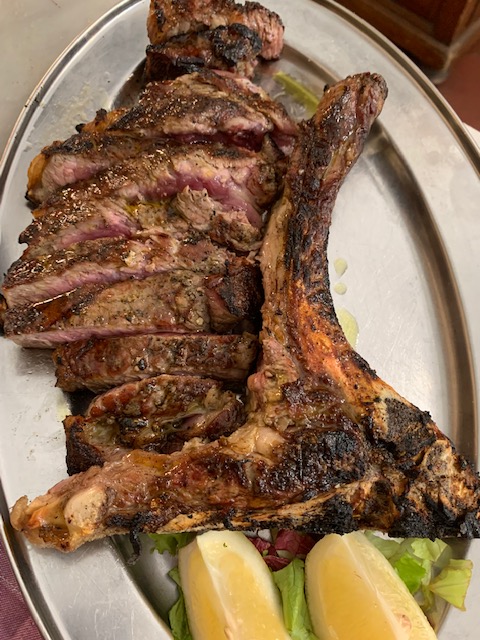
I had read about Tuscan and Florentine culinary specialties and was very excited to try Bisteca alla Florentine, which is a thick T-bone of Chianina beef (an Italian breed of cow that have been raised in Tuscany and surrounding regions for over 2200 years) served by the kilogram (1kg = 2.2lb). The steak is seared on both sides and served rare. I can take or leave a filet but serve me steak on the bone and I’m one happy gal. Pretty much every restaurant we passed by served Bisteca alla Florentine. In doing my research, the Trattoria Sergio Gozzi, which has been serving up the beefy goodness since 1915, was the place to go (and was still frequented by locals). During the week the restaurant is only open from 12-3pm and I had read that, in order to snag a table, one should arrive before 12:30.
We arrived just before 12:30 and were told we would have a 10 minute wait so we sipped prosecco outside while we waited in the bright, hot Tuscan sun and in no time the waiter ushered us in. We were seated at an antique, dark wooden, table that I couldn’t help but think must have been there since 1915. In fact, the only two chairs at the table were on the same side to allow room in front of the table for the waiters to pass by. I had read that the restaurant did not take reservations, though that was obviously not the case when the woman at the bar asked me if we had one when we entered. I felt lucky that we scored a table as a couple that arrived a few minutes after us were turned away. I assume because there are only so many people they can serve in a three-hour window and the remaining tables were spoken for. I snapped a photo of the back dining room as we were seated.
We ordered a 1kg steak, the minimum amount one could order and the amount suggested for two people. The chef came out from the kitchen so show us the steak he was going to prepare for us. I smiled, nodded happily, and he headed back to the kitchen. To accompany the steak we chose the Tuscan white beans (another local specialty), sauteed spinach, and fries. We also had bread and a carafe of Chianti that pairs well with the Chianina.
Very shortly, out came our feast. The steak was cut into slices and served with the bone. It was delicious. After several slices, I put the giant bone on my plate and managed to cut off a few tasty, crispy, fatty morsels. Had I been at home, I would have picked it up with my hands and gone to town. In retrospect, I should have asked if I could have the bone wrapped up “to take home to my dog.” For desert we split a small zuccotto; a tasty little dessert make with Italian liqueur, cake and ice cream (which hides inside for a delightful surprise).
Back to the Art. The highlight of our trip for me was seeing Michelangelo’s David. I have been lucky enough to have viewed many amazing, famous, historical works of art in my life, and David is one of the most impressive, and far exceeded my expectations. I didn’t realize how big the statue is. He is massive, standing 17 feet above the roughly 7 foot (this is my personal guess as the internet is not giving me a consensus) pedestal he is standing on, and is perfect from every angle. The veins and knuckles in his hands and feet, his muscles, the little indentations beside his knee caps, and as my mom said when I sent her some photos, “nice butt!”
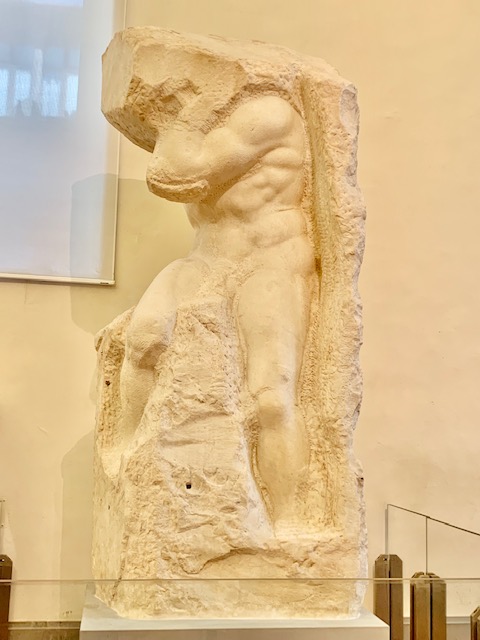
In addition to David, the Galleria dell’Accademia, which is his home, houses several unfinished Michelangelo sculptures. It was really cool to see the figures that seem to be both actively emerging from the marble and frozen forever, unrealized.
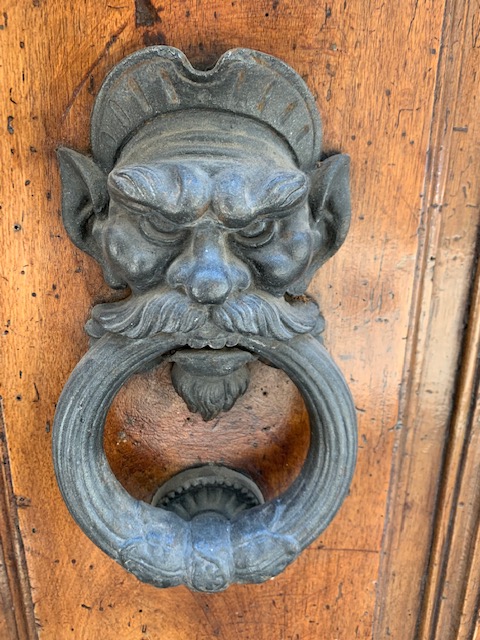
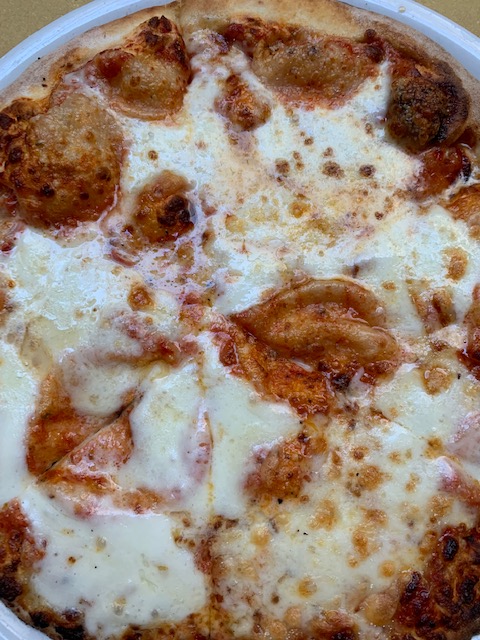
We saw many other wonderful things while in Florence, and Phil wrote a detailed account of our trip here. I highly suggested you check it out. He also dedicated another post solely to some of the beautiful art we saw. Below I am going to leave some random photos of our trip. I hope you enjoy them. What can I say, we like pizza.
Shortly after we moved to Gijón and had witnessed some lovely sunsets, I told Phil that we need to get up early and watch the sunrise (Amanecer in Spanish). We are not necessarily waking up before sunrise kind of people, so aiming to see the sunrise at least once, was a fairly reasonable goal.
My mother recently made a comment about how late the sunrise is in here, compared to Missouri. Not having a job or anything in particular we have to get up early for on a regular basis means I usually roll out of bed somewhere between 8:30 and 9:30 a.m. so I had no idea when the sun was rising. I told Phil that we should take advantage of the late sunrise sooner than later since Spain participates in daylight savings and we’d soon be moving our clocks forward an hour (the last Sunday in October to be exact).
Earlier this week I happened to see that the sun was rising at 8:35 and thought, now is the time. Getting up at the crack of 7:00 to watch the sunrise is waaaaaaay better than, well it’s better than getting up before 7:00. We decided the best place within in a reasonable distance to watch the sunrise was in front of the Hotel La Colina (which I mentioned in this post). The hotel is about an hour walk from our apartment, so we decided to take the bus and then walk back. We accidentally got off the bus a few stops too early (in our defense, there were three stops with Providencia in the name) so ended up having about a half-hour walk to the hotel from the bus stop. We did have a lovely view of the city as we climbed the hill (escalar, escalar).
Luckily, we’d given ourselves plenty of time. As we neared the hotel, we saw the faint, baby blue light slowly begin to illumine the eastern sky. We rounded the corner of the hotel just as the horizon began to glow orange and pink.
As sat on the wooden bench perched perfectly on a flat patch of grass overlooking the sea, arms wrapped around each other (both out of love and need for warmth), I caught myself in the moment. I called attention to it in my mind and instead of holding on to it, I just lived it. It is difficult sometimes, because we are living such amazing experiences, not to try to hold on tight to each one. The thing is though, you can’t fit very much into a white-knuckle fist. So, when I catch myself (I don’t always catch myself) holding on too tight, I simply take a deep breath, feel grateful, and jump out of my head and into the moment.
The sun was up by 8:34 and shortly thereafter, we headed back toward Gijón along the cobblestone path. As we walked through the rolling hills, the sunrise followed us and we were able to experience it a few times as it peaked over one hill to the next.
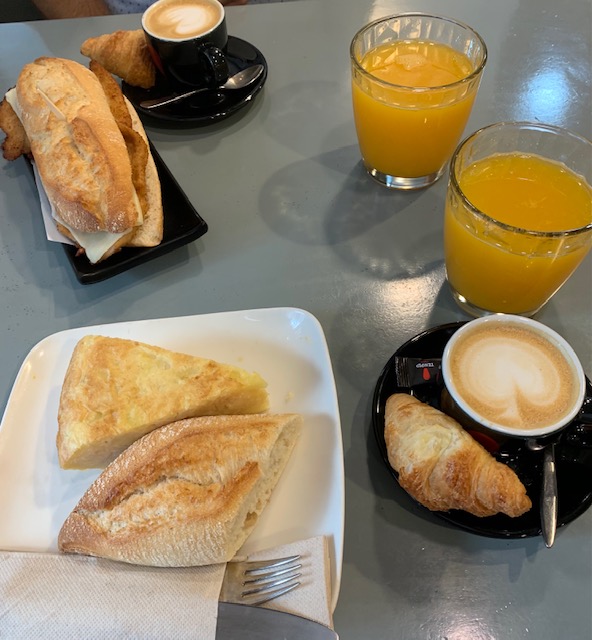
I was STARVING by the time we got back into the city so we stopped at one of the many cafe’s and had desayuno (breakfast). Often (constantly) when we are walking, I point to various cafe’s, restaurants, and sideria’s and say, “Oh, that’s a cute little place” or “That place looks nice,” always finishing with “we should go there.” This morning we went “there,” to cafe El Viejo, a cute little place. I am not sure if I’ve mentioned this before or not, but Spain has THE best orange juice. It is always a fresh squeezed glass of sunshine. The fact that it is served room temperature and not cold, does not even touch the deliciousness factor in the slightest. In fact, I think the only reason they don’t serve it cold is because constant moans of delight would annoy the waitresses.
We enjoyed our morning so much, I think we may try to see another sunrise before the end of the October. L-I-V-I-N.
*I didn’t forget about my Florence post. I just wanted to type this one up while it’s still fresh in my mind.
Ten or so years ago, I won a painting by a Portuguese artist named Nagualero, that he was giving away in an online drawing. I felt very lucky to have won as there were many, many entrants. The painting’s title was, “Make Your Own Luck.” Phil and I take this sentiment to heart and try to make our own luck in life as much as possible.
Make Your Own Luck
I am very grateful to be able to enjoy a year of mid-career retirement to live in Spain. It is truly amazing and I am thankful everyday that things worked out for us to be able to live this dream. A few times since we’ve been here, I have had folks from back home tell me, “You are so lucky that you get to live in Spain.” While I know their intention was to express their happiness for me and us, my initial, internal reaction to this statement, was mild defensiveness. Why? Well, when I heard, “You’re so lucky,” I felt that it implied this is something that was given to us, like we won a scratch-off lotto ticket and the grand prize was a year in Spain.
Our move was something that took planning, hard work, and saving. We took funds from savings that would have gone toward our later life retirement and are using it now. Plus, we do not have children, so we do not have all of the expenses that go along with having kids. After my initial defensive thoughts, however, I thought about all the ways in which luck has indeed played a role in getting me here; I am educated, I have had good career opportunities and well paying jobs, I was born white and benefit from all of the privilege that it entails, and I have wonderful partner and love of my life who encourages me and cheers me on in accomplishing my goals.
To continue with making our own luck, Phil and I recently traveled to Italy. What started out as looking at cheap airfare to Romania, turned into buying tickets to Milan. We had been to Milan before and knew we did not want to spend much time there. We debated a bit about which way to travel from Milan and ultimately decided to visit Cinque Terre and Florence. After arriving in Milan around 10pm, we headed to our hotel near the train station, grabbed a quick bite; the first of many pizza margherita’s we would enjoy during our trip. The next morning, we headed to the train station and rode the three hour trip to La Spezia, a city just outside of Cinque Terre. La Spezia is conveniently located and much cheaper than staying in Cinque Terre. It also has its own happening vibe and we enjoyed our time there. In fact, we initially planned to drop our bags at our hotel in La Spezia and immediately head to Cinque Terre via the quick and easy train that runs throughout the day but we decided instead to explore La Spezia. We walked around the marina near the port and enjoyed leisurely drinks at a couple of spots near the water before heading to our dinner reservation.
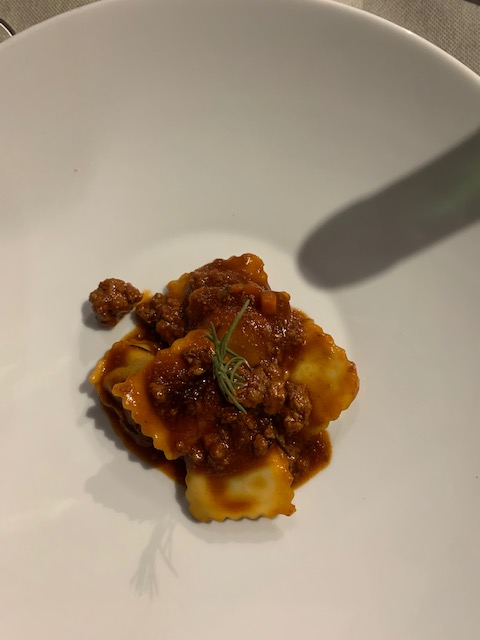
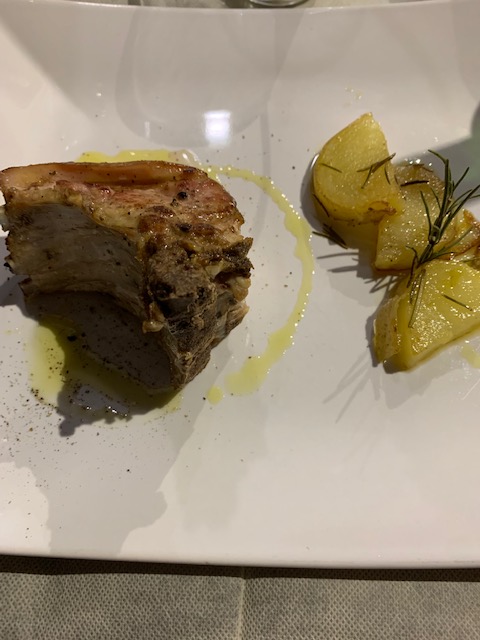
Al Solita Posto was the name of the cute little place we had dinner. We chose a table outside and were the only diners. We passed several bustling patios on the walk there, so felt lucky to have the whole patio to ourselves. We wanted to try several dishes on the menu and opted to split them all as a favor to both our bank account and bellies. The chef was nice enough to plate our portions separately and the presentation was lovely. We ordered lamelle de anatra e carciofi friti (duck with fried artichokes), ravioli della nostra (a traditional ravioli in beef ragu), and pork belly with potatoes and rosemary. We did, however, each opt for a desert because, well, we like desert. I cannot remember the name of the deserts but were both really good. I’m just going to call them a pistachio ice cream yum and the other a chocolate something good.
Enjoying our private patio
Ravioli
Pork belly
Pistachio yum and chocolate something good
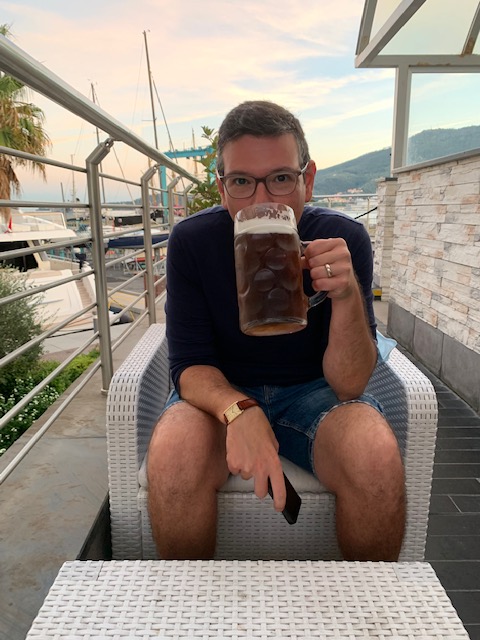
After we ordered our food, Phil went inside to use the restroom and the waitress came outside to bring our wine. As she opened the bottle, she started asking about where we were from and what we were doing in Italy. I was feeling particularly chatty after Phil accidentally ordered us each a liter of freakin beer at the last place we stopped at in the marina, so I told her all about the pandemic being a wake up call and our process of moving from L. A. to Spain (you can read about what brought us to Spain here, if you haven’t already). After my needlessly long-winded answer to the sweet woman’s question, she replied very sincerely as she looked me in the eyes,”You are a very lucky girl” and the response that immediately popped into my head, which I did not say out-loud was “don’t I fucking know it, lady.” Instead, I simply said, “Yes, I am,” and she headed back inside. And that was that. I am lucky. I do know it. We’ve made our own luck and we’ve happened into luck but we are lucky. I am lucky.
Oops, giant beer
Well, if I have to
The next day, we headed to the marina to get our tickets for the Cinque Terre boat taxi. Cinque Terre is a string of five, centuries old, seaside villages built into the cliff-side on the Italian riviera. Cinque Terre actually reminds me a lot of the Asturian village of Cudillero that I wrote about when my cousin, Hannah, visited. There are hiking trails between the villages and a train that runs through them all but we opted for the boat taxi and it was very cool to see each village from the water.
Our first stop was the village of Vernazza. We passed the crowds and restaurants of the main square and made our way up some of the narrow, climbing, stone staircases. We happened upon the coolest, family-run restaurant with breath-taking views near the top of a very narrow staircase. Years ago, I pinned the following photo to my Pinterest vision board (go ahead, roll your eyes):
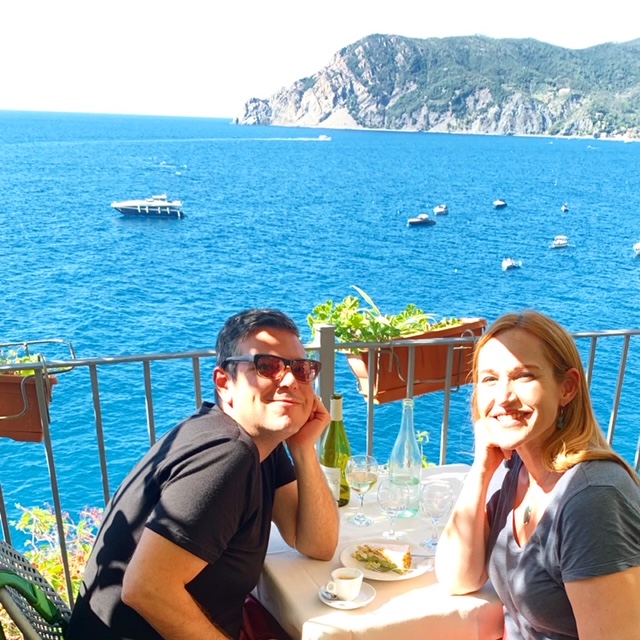
At the time I pinned it, I had no idea where it was, just that it was a beautiful place and I thought, “I want to go there!” I am now almost certain the photo is of Cinque Terre. The restaurant Phil and I ate at recreated this vision for me almost exactly:
As I sat there with the man I love, looking town on the sea, the boats, and the village, I thought to myself, “I am a very lucky girl.”
Phil wrote about our trip to Italy here and here. We try not to write the same details or stories, so check out his blog for additional information and photos. Stay tuned for another post from me soon about our time in Florence.
I intended to post this on 9/22/21 but did not finish it in time before Phil and I left for a week’s trip to Italy, so the timeline mentioned is a week off. Posts coming soon about the Italy trip!
Recently, Phil and I attended a meetup group in the nearby town and capital of Asturias, Oviedo. The group was an intercambio (language exchange) group. When we arrived in Oviedo that evening, we were very surprised to find a LOT of people and happenings. It was, unbeknownst to us, the first day of Las Fiestas de San Mateo (The festival of Saint Matthew), a ten day festival. It was intense.
We met the group at a local bakery; Oscar, the facilitator, Teresa, Oscar’s friend who was visiting from Sevilla, Carlos, an abogado (attorney) from Oviedo, and Cris, Oscar’s co-worker with whom he teaches English at a local public school. As the exchange began, we spoke mostly in English but after about thirty minutes, transitioned into Spanish. We spoke a bit and listened a lot. It’s exciting to me that I am beginning to understand Spanish much more. We walked to another establishment and sat outside and shared a few bottles of sidra. After sharing the sidra, some stories, and a few laughs, the liveliness in the streets felt less intense and much more jubilant.
After Phil and I boarded our 12:30 a.m. bus back to Gijon, we decided we wanted to return the following Saturday to experience a bit more of the San Mateo festivities, specifically earlier in the day before everything evolved into a drunken street party (not that there’s anything wrong with that. Three cheers for drunken street parties!). So, this past Saturday, we did just that, arriving in Oviedo around 4:30 p.m. I had been jokingly been referring to the festivities as “San Mateo Days” to Phil as a nod to the small, Midwestern summer and fall festivals I grew up with. In fact, it felt very similar to a festival in the states; vendors selling handmade, artisanal wears,carnival rides, and food and drink vendors
One of the most popular days of the festival is the Day of the Americas. During the Day of the Americas, Asturians celebrate Indianos. Indiano is the name given to Spanish emigrants who left Asturias to seek their fortune in Latin America and who returned, years later, fortunes amassed and built large homes, often established charities and cultural institutions, subsidized the building of new schools, churches, town halls, etc.
As we sat out and enjoyed a mojito (a nod to Cuba) on one of the many bustling restaurant patios, we watched several bands and dancers parade through the street, decked out in Ecuadorian, Colombian, and Mexican colors and flags, respectively. It was muy divertido e interesante. After patio hopping a bit, we decided we needed some food and ducked into a cute little bar/restaurant that had a very hip vibe and low lighting. We ordered the nachos, in keeping with the Day of the Americas theme. They were interesting. Two separate, small dishes, one with ground chorizo covered in a white sauce (not cheese, not sour cream, not sure) and in the other refried beans with a greenish, sweet sauce drizzled over them. The beans were, well, sweet. I don’t know if it was just she sauce or both beans and sauce but they were sweet. I’ve had Korean sweet treats made with bean, so I know beans and sweet can go together but it was a bit strange in my nachos. We were hungry and I like chorizo, beans (sweetness be dammed), and tortilla chips, so we ate them all. In the future, however, I believe I will reserve my nacho consumption for Mexican restaurants (there are a couple in Gijon) and my home (because I make bomb-ass nachos).
San Mateo Days!
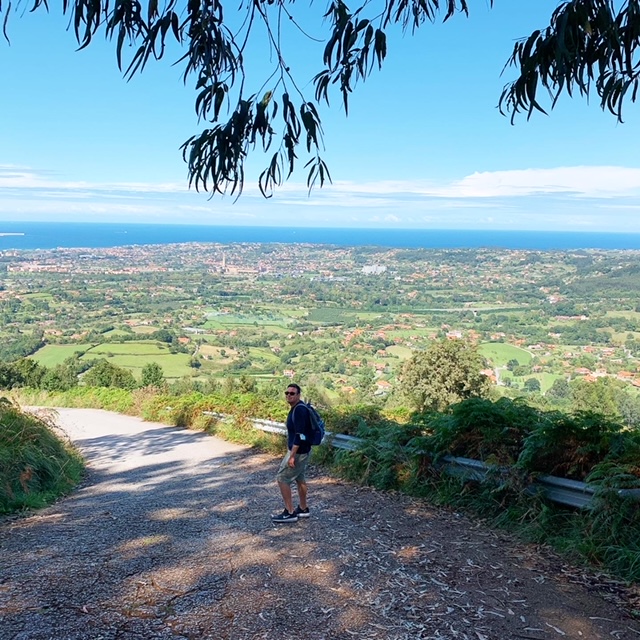
When we woke up late the following morning, we decided to take the bus to Área recreativa de Monte Deva. Deva is a parish within the municipality of Gijon, a bit outside of the city. The area has several points of interest, including the recreation area and observatory. We decided to head toward the observatory. Now, admittedly, the fact that we were walking to an observatory should have clued us into the fact that we would be climbing up and it did, kind of. As I’ve mentioned before anytime we go anywhere in Asturias we wind up climbing (escalar, escalar), so it wasn’t surprising that the route to the observatory was at an incline. It was very surprising, however, when the incline continued to get steeper and seemed to never end. Up we went as we zigged and zagged ever more, ascending, hoping in vain that after each turn the road would level off. It had to level off at some point, right?
Sweating, panting, and several rest breaks (there were no benches on this route, so rests were taken leaning against a guard rail, fence or tree. At one point I just yogi squatted because I just couldn’t stand anymore) later, we finally reached the area de recreativa. Phil and I are both a little foggy as to exactly how long the climb up took but it was at least an hour and a half. Once at the top, we sat and caught our breath for a while. Phil refilled our water bottle at the natural water fountain, where there happened to be three horses, just chilling. There were several families in the area grilling at the large, charcoal grills provided and a few tents from folks who had camped there overnight.
We found a spot at an empty picnic table with a lovely view of the city and ate the bocadillos (sandwiches on baguettes) and apples we had packed for lunch. Phil suggested I check my phone to see how many [equivalent to] flights of steps we’d climbed reaching the top. I was shocked to see that my phone read seven flights. “Seven?!” I couldn’t believe it and then thought, “Wow, I must be really out of shape.”
View from the top
We did not walk up to the actual observatory as we had a spectacular view of the city from the area de recreativa and (after a quick google review read by Phil), we decided it was really best suited for a night time star gaze as opposed to a daylight visit. Before we began our decent, I checked my phone again as service was spotty and could not believe we’d only climbed seven flights. Upon opening my phone, I saw this:
Seventy-two floors! Holy moly! It wasn’t until we started walking back down that we realized just how steep of an incline we’d climbed. Had I known when we started, I don’t think I would have walked up (especially after a night of mojitos) but it sure felt like an accomplishment after the fact. After heading back down the mountain, we decided to stop and grab a tinto de verano and croquetas at the restaurant near the bottom. It was a super cute spot where you ordered inside at the small bar and then waited in the large grassy area, covered in picnic tables for them to bring out your order. Before catching the bus back to Gijon we sat in the sunshine, contented smiles on our faces, respirando el aire fresco.
Lately I have been thinking about the idea of home and the different houses I’ve called home and what home really means to me. My first memory of home, is my childhood home, the first house I shared as a young child with my parents and brother. I remember in the winter, my mom would wake us up in the morning, and, in the living room she had our clothes laid out on the fireplace so we could stay nice and warm as we dressed for the day. I remember spending Christmas morning as a family, sitting on the floor in front of that same fireplace, my parents drinking coffee and my brother and I playing with our new toys and laughing. I remember my mom rocking me in her rocking chair in that house, whenever I was sick or upset. That was home.
It’s not the house we shared that I remember as home, though I try my best to do that too sometimes, being thirty-something years since I’ve seen it. It’s the feeling I remember. The feeling of home; love, warmth, safety, security, and contentment, all combined. I remember being in my late teens, having moved out of my parents home and trying to navigate that sometimes scary place between adolescence and adulthood, and longing for the feeling of being a child, in my mother’s arms, in the rocking chair. I was searching for my new home.
As a gerontologist, I have worked with many older adults with dementia over the years. Often, they will repetitively say, “I want to go home” or maybe even pack their belongings in the middle of the night and try to leave. When asked where they’re going, they will respond, “I’m going home.” They may do this even while residing in a home they have owned for fifty years. A home they raised kids in and lived with their spouse. When they say they want to go home, they mean that first memory of home. A memory they still hold (longest held memories are the very last to go) or, more accurately, a feeling they still hold. They may not know what is wrong but they know something is wrong and they want to go home, to feel home; safe, warm, loved, at ease.
A good friend can certainly feel like home. One of those friends that you can go for months or years without seeing and when you’re together again, it’s like no time has passed. You get together and instantly it’s like you’ve climbed into your favorite pair of jammies and are sipping hot cocoa.
Phil and I bought our first house together in St. Louis and made it a home. That was the first place I’d lived since my childhood that felt like home. I was with my love, we had a cozy little bungalow filled with our personal belongings, and our dog, and it was perfect. I would come home from a long day (or week if I was traveling) of work and sigh contentedly as I opened the door. Home.
After my brother died in 2009, I lost my feeling of home. For about a year and a half, I didn’t feel at home anywhere; not in my house, my own skin, or my head. Let me tell you, that is an empty feeling. Actually, it’s not even a feeling. It is the total lack of feeling. Good thing I have a really awesome husband who never gave up on getting his wife back. Also good thing I had enough sense to find a therapist (who encouraged me to try yoga) and a psychiatrist. I eventually became accustomed to my new normal and found home once again.
When Phil and I were preparing to move from St. Louis to California, I struggled with letting go of our house. My cozy little bungalow and all my cool stuff that I had to get rid of before the move. Eventually, it clicked that all of my stuff was just stuff and my house was just a thing. Phil was home. Phil and I together made the home. The only other thing in the house that mattered was our sweet dog, Jebus, and he was coming with, so I had everything I needed. I have never once missed that house since we left. It was a good house and I’m happy we had our time there but I don’t miss it. Ever.
We had a couple of months of limbo before moving to Gijon while we were waiting to hear back from the Spanish consulate about our visas. Our apartment sat, half packed, in disarray and we split our time between Long Beach and Palm Springs (where my father-in-law had an Airbnb he couldn’t rent at the time due to covid restrictions). I remember being in Palm Springs and as I went to grab something out my suitcase one night thinking, “I’m going to be living out of a suitcase for a really long time.” The thought didn’t scare me or make me sad. It was simply a matter of fact. A permanent address does not a home make.
Gijon feels like home now. We didn’t realize it until a few weeks ago, after my cousin Hannah visited and we returned from a few days away. As we drove into the city and neared the bus station, Phil said, “It’s good to be home,” and it was. Home. It doesn’t feel like home because our stuff is here, because our stuff is in fact, not here (well, our clothes and shoes are here).
Maybe home is never a place. For anyone. There’s no place like home because Dorothy knows everyone she loves is there, not because Kansas is such a bomb-ass place to live. People can relocate. You can find new people. You can make your home wherever, and with whomever you want. The saying should really be “Home is where your heartbeat is” or maybe “If you lived here, you’d be home by now,” “Oh yeah, jokes on you, I live nowhere near here and I feel right at home!”









































































 Jess Barrington Travels